Most companies approach RFPs the same way.
They answer the questions.
Attach their certifications.
Submit the proposal.
And then… they lose to someone else.
Not because they weren’t qualified.
But because they didn’t stand out.
Here’s the reality:
Most RFP responses sound exactly the same.
And when everything sounds the same, buyers default to:
- Price
- Familiar vendors
- Or the company that feels lowest risk
That’s where ISO and R2 certifications can give you a real advantage —but only if you use them the right way.
The Problem: Certifications Get Buried in RFPs
Most companies treat certifications like a checkbox.
They’ll write something like:
“We are ISO 9001, ISO 14001, ISO 45001, and R2v3 certified.”
And that’s it.
No explanation. No differentiation. No impact.
From the buyer’s perspective, that doesn’t stand out — it blends in.
What Buyers Are Actually Looking For
When reviewing RFPs, buyers aren’t just scoring requirements.
They’re asking:
- “Who is going to make this easiest for us?”
- “Who is least likely to create problems?”
- “Who can we trust to deliver without constant oversight?”
That’s the lens everything is evaluated through.
And this is where certifications can either:
- Help you win
- Or do absolutely nothing
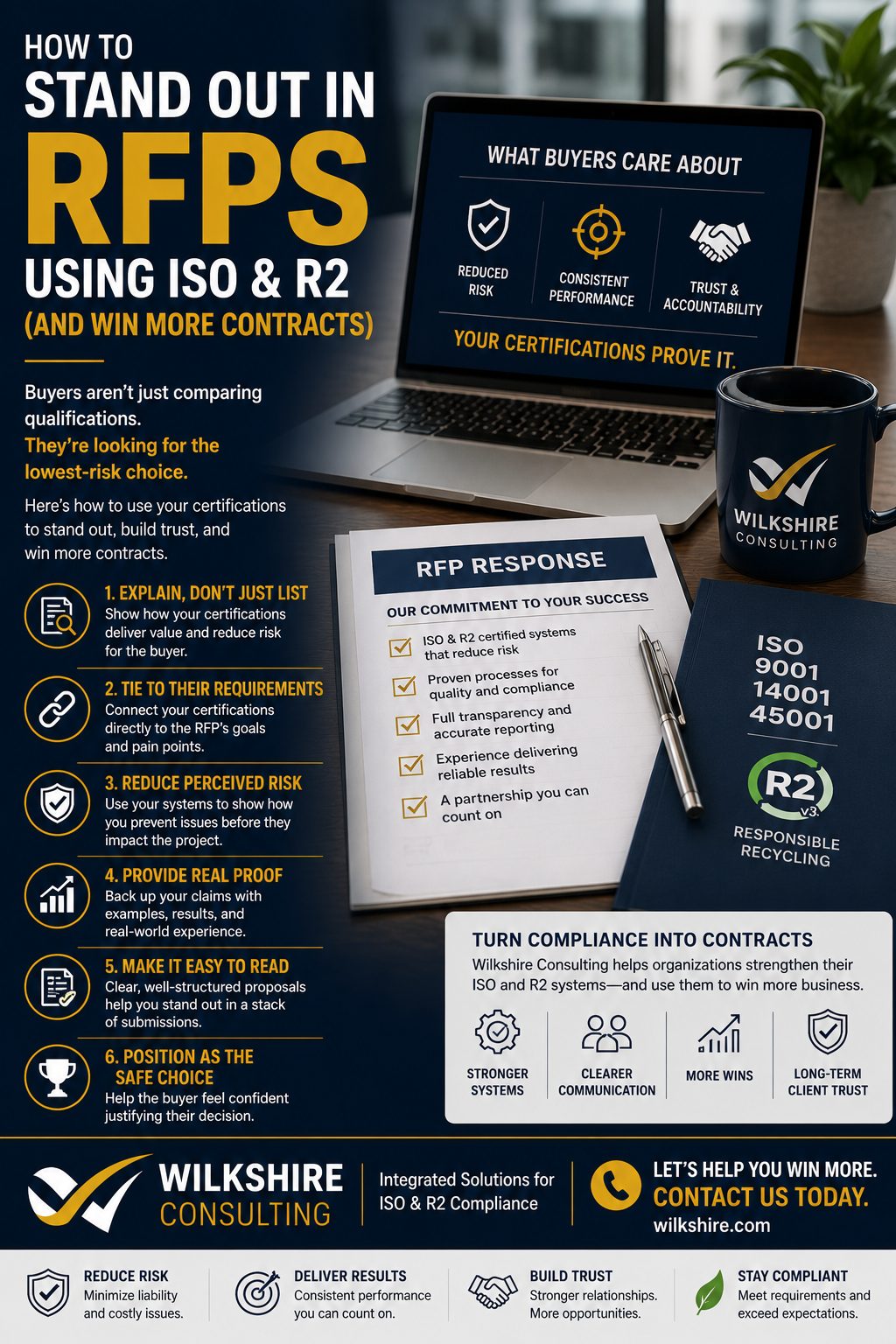
Step 1: Stop Listing Certifications — Start Explaining Them
Listing certifications tells the buyer what you have.
Explaining them shows why it matters.
Example:
Weak response:
“We are R2v3 certified.”
Stronger response:
“Our R2v3 certification ensures full downstream tracking and verified data destruction, which reduces your environmental and data liability.”
Now you’re speaking their language: Risk reduction
Step 2: Tie Certifications Directly to Their Requirements
Every RFP has pain points hidden inside it:
- Timelines
- Compliance
- Risk
- Reporting
- Accountability
Your job is to connect your certifications directly to those.
Example:
If the RFP mentions data security:
“Our R2v3 processes ensure every device is tracked and verified through final disposition, eliminating gaps in chain of custody.”
If it mentions quality or consistency:
“Our ISO 9001 system standardizes our process, reducing variability and ensuring consistent results across all projects.”
Now your response feels tailored — not generic.
Step 3: Use Certifications to Reduce Buyer Risk
Here’s the truth most companies don’t say out loud:
RFP decisions are risk decisions.
The buyer is thinking:
“If something goes wrong, who do I trust?”
Certifications help answer that — but only if you make it clear.
Example:
“Our integrated ISO and R2 systems are designed to identify issues early and prevent repeat problems, reducing the risk of delays, compliance gaps, and rework.”
That’s powerful.
Because now you’re not just answering the RFP…
You’re making the buyer feel safer choosing you.
Step 4: Add Proof — Not Just Claims
This is where most proposals fall flat.
They make claims… but don’t back them up.
Even a simple example changes everything.
Example:
“We recently worked with a client who had experienced multiple downstream tracking issues with a previous vendor. By implementing our R2-controlled process, we were able to eliminate tracking gaps and provide full transparency within the first reporting cycle.”
Now your certification feels real.
Step 5: Make Your Proposal Easier to Read
This is overlooked — but critical.
Most RFP responses are:
- Dense
- Wordy
- Hard to scan
Buyers are reading dozens of these.
If your proposal is easier to read, you immediately stand out.
Simple improvements:
- Use bullet points
- Use bold headers
- Keep paragraphs short
- Highlight key outcomes
Your certifications should be easy to see and understand quickly.
Step 6: Reinforce Your Position as the “Safe Choice”
At the end of the day, most buyers want to justify their decision internally.
Your proposal should help them say:
“This is the safest option.”
Certifications support that — but you have to connect the dots.
Example closing statement:
“Our ISO and R2-certified systems are built to reduce risk, ensure consistency, and provide full accountability — making us a reliable partner for long-term success.”
That’s what decision-makers want to hear.
The Companies That Win RFPs Do This Better
We see this all the time.
Average companies:
- Answer the questions
- List certifications
- Submit
Winning companies:
- Translate certifications into value
- Tie them to buyer concerns
- Reduce perceived risk
- Make their proposal easy to understand
That’s the difference.
How Wilkshire Consulting Helps You Win More Contracts
At Wilkshire Consulting, we help companies go beyond certification — and actually use their systems to win business.
We work with organizations to:
- Strengthen ISO and R2 systems
- Align processes with real client expectations
- Improve how certifications are communicated in RFPs
- Position them as the lowest-risk, highest-value option
Because the goal isn’t just to qualify for RFPs.
It’s to win them.
Ready to Turn Your Certifications Into a Competitive Advantage?
If you’re submitting RFPs but not winning as often as you should — your certifications may not be working as hard as they could.
Or if you’re preparing for ISO or R2 certification and want to build it the right way from the start, we can help.