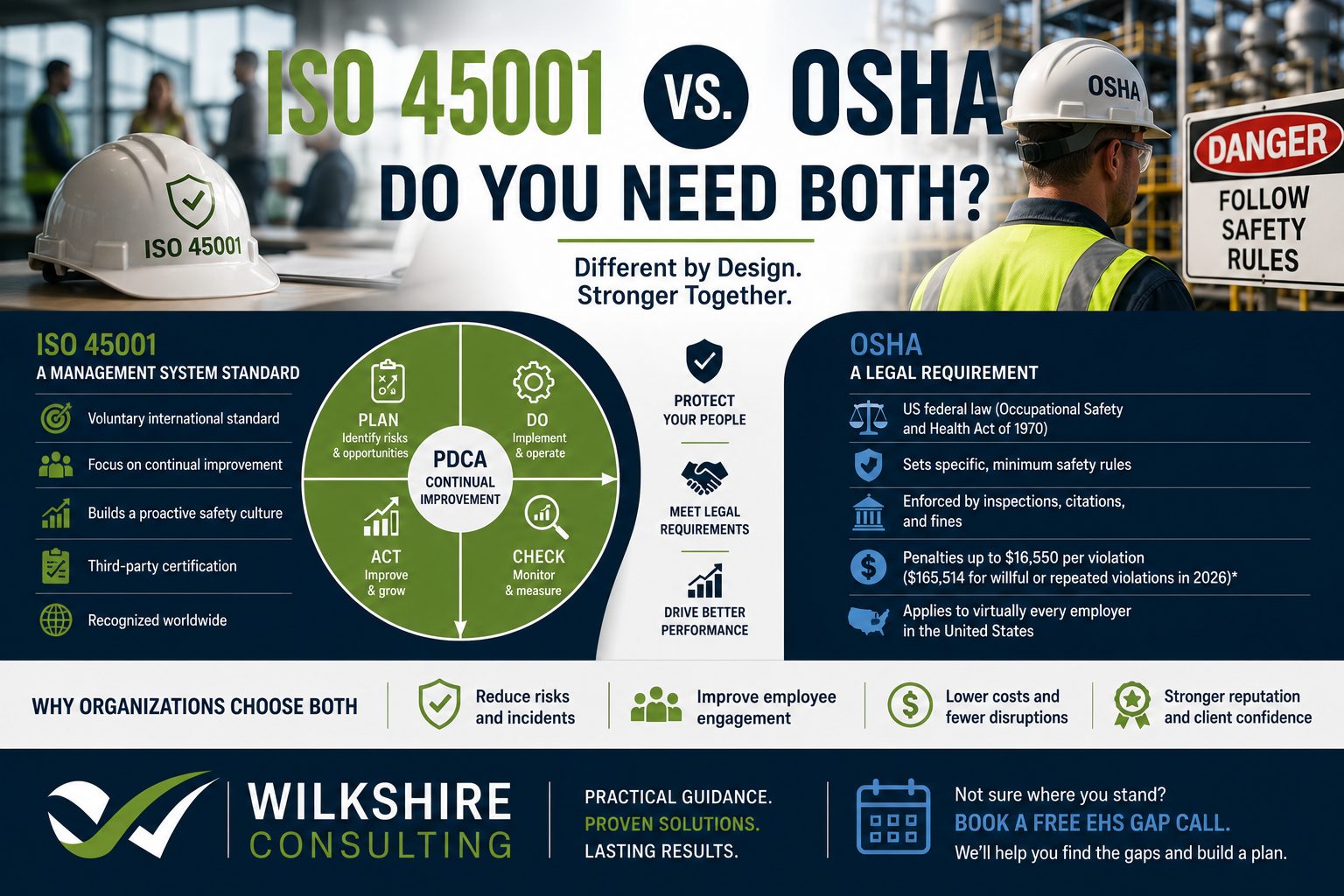
Short answer: no, ISO 45001 and OSHA are not the same thing, and getting ISO 45001 certified does not get you out of OSHA compliance. If you operate in the US, OSHA is the law, full stop. ISO 45001 is a voluntary management system standard that sits on top of that legal floor and done well, makes staying compliant a lot less stressful.
We hear this question a lot from clients who’ve just started looking into ISO 45001 and assume it’s some kind of upgraded OSHA program. It isn’t — but understanding how the two actually relate is the difference between building a safety program that just checks boxes and one that actually holds up.
What OSHA Actually Requires
OSHA — the Occupational Safety and Health Administration — enforces the Occupational Safety and Health Act of 1970. It’s federal law, not optional, not something you opt into. It covers general industry under 29 CFR 1910, construction under 1926, plus maritime and agriculture, along with the General Duty Clause that catches hazards not spelled out elsewhere in the regs.
OSHA tells you what you must do, in specific terms: provide fall protection above a certain height, guard specific machinery, maintain specific recordkeeping. It enforces through inspections, citations, and fines — and those fines aren’t small. Serious violations can run up to $16,550 per violation, with willful or repeated violations reaching $165,514 per violation in 2026. There’s no certificate for OSHA compliance.
You’re either compliant or you’re exposed.
What ISO 45001 Actually Is
ISO 45001 is the international standard for occupational health and safety management systems, published in 2018 as the replacement for OHSAS 18001 (that migration deadline passed back in September 2021 — if your business is still running on OHSAS 18001, it’s officially outdated). Unlike OSHA, it’s voluntary. There’s no government agency requiring it. Instead, third-party certification bodies audit your organization against the standard and issue certification if you meet it.
Where OSHA hands you a list of specific rules, ISO 45001 hands you a framework for how to manage safety as a system — built around the same Plan-Do-Check-Act structure used in ISO 9001 and ISO 14001, which is part of why organizations already running one of those standards find ISO 45001 easier to bolt on. It requires leadership to actually own safety performance (not delegate it and disappear), it requires worker participation in identifying hazards, and it pushes toward continual improvement rather than a one-time pass/fail inspection.
It’s also growing fast. Globally, ISO 45001 certifications have nearly tripled since 2020, with over half a million organizations now certified. That’s not a niche credential anymore — it’s becoming an expected baseline in a lot of industries, especially where clients or insurers ask for proof of a real safety management system.
The Core Difference, Side by Side
OSHA
ISO 45001
What it is
US federal law
Voluntary international standard
Mandatory?
Yes, if you operate in the US
No — but increasingly expected by clients/insurers
Enforcement
Government inspections, citations, fines
Third-party certification audits
Focus
Specific, minimum safety rules
Management system for continual improvement
Proof of compliance
No certificate — you’re either compliant or cited
Formal certification, renewed every 3 years with annual surveillance audits
Geographic scope
United States only
Recognized globally
Do You Need Both?
If you operate in the US, OSHA compliance isn’t a question — it’s mandatory regardless of whether you ever pursue ISO 45001. The real question is whether ISO 45001 is worth adding on top.
For a lot of organizations, yes. ISO 45001 doesn’t replace your OSHA obligations, but a well-run ISO 45001 system tends to make OSHA compliance a natural byproduct rather than a separate scramble every time an inspector shows up. Instead of treating safety as a checklist you revisit when something goes wrong, you’re running a system that’s supposed to catch problems before they become violations — or worse, incidents.
There’s also a business case that has nothing to do with avoiding fines. Organizations with mature ISO 45001 systems consistently report lower incident rates and lower workers’ comp costs. And certification itself has become a real differentiator with clients, insurers, and in some cases regulators who want documented proof you’re managing safety proactively, not just reactively.
What ISO 45001 Adds That OSHA Doesn’t Touch
OSHA’s General Duty Clause and specific standards are reactive by design — they respond to known hazards with known controls. ISO 45001 pushes further: it requires you to understand your organizational context, actively involve workers in hazard identification (not just training them on hazards you’ve already identified), set measurable safety objectives, and revisit your system regularly through internal audits and management review. None of that is required by OSHA. All of it tends to reduce how often OSHA becomes a problem in the first place.
Quick answers:
Does ISO 45001 certification exempt us from OSHA inspections?
No. OSHA applies to virtually every US employer regardless of what certifications you hold.
Is ISO 45001 required by law?
No — it’s voluntary. OSHA compliance is the legal requirement.
How often does ISO 45001 certification need to be renewed?
Recertification typically happens every three years, with annual surveillance audits in between.
If we’re already OSHA compliant, do we still need ISO 45001?
Not necessarily — but if you’re managing safety reactively, dealing with recurring incidents, or fielding client/insurer requests for a documented safety management system, ISO 45001 gives you the structure OSHA compliance alone doesn’t provide.
Not sure where your current safety program actually stands against ISO 45001? Book a free EHS gap call and we’ll walk through it together.