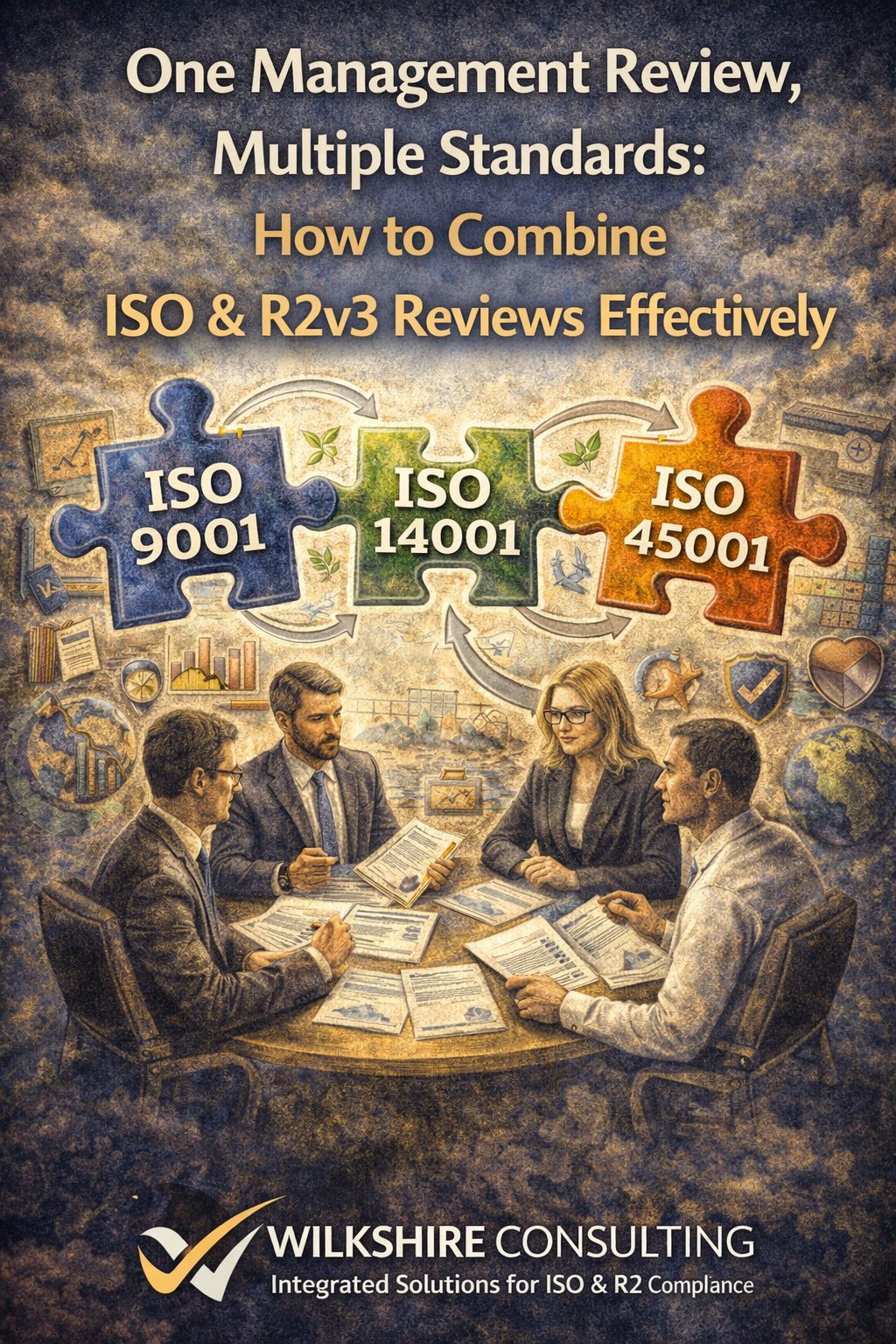
Management review is one of the most important — and most underutilized — elements of any ISO or R2v3 management system.
Most organizations treat it as a requirement to satisfy auditors:
- Schedule a meeting
- Review required inputs
- Document minutes
- Move on
But ISO standards and R2v3 were not designed for passive review. They were designed to give leadership a complete picture of organizational performance, risk, and opportunity.
The problem is that many organizations conduct separate management reviews for each standard — ISO 9001, ISO 14001, ISO 45001, and R2v3.
The result is duplication, inefficiency, and missed insight.
An integrated management review transforms this process into a strategic decision-making tool.
Why Separate Management Reviews Don’t Work
Running separate reviews for each standard creates several issues:
- Repetitive discussions across meetings
- Conflicting priorities between departments
- Increased time burden for leadership
- Fragmented understanding of risk
For example:
- A quality issue may have environmental implications
- A safety concern may impact operational efficiency
- A downstream vendor issue may affect both compliance and customer trust
When these topics are reviewed separately, leadership loses the ability to see how they connect.
What Standards Actually Require
ISO 9001, ISO 14001, ISO 45001, and R2v3 all require management review — but the required inputs are highly similar:
- Performance metrics
- Audit results
- Nonconformities and corrective actions
- Changes affecting the system
- Risks and opportunities
- Resource needs
There is no requirement to review these separately.
In fact, the standards are intentionally aligned to support integration.
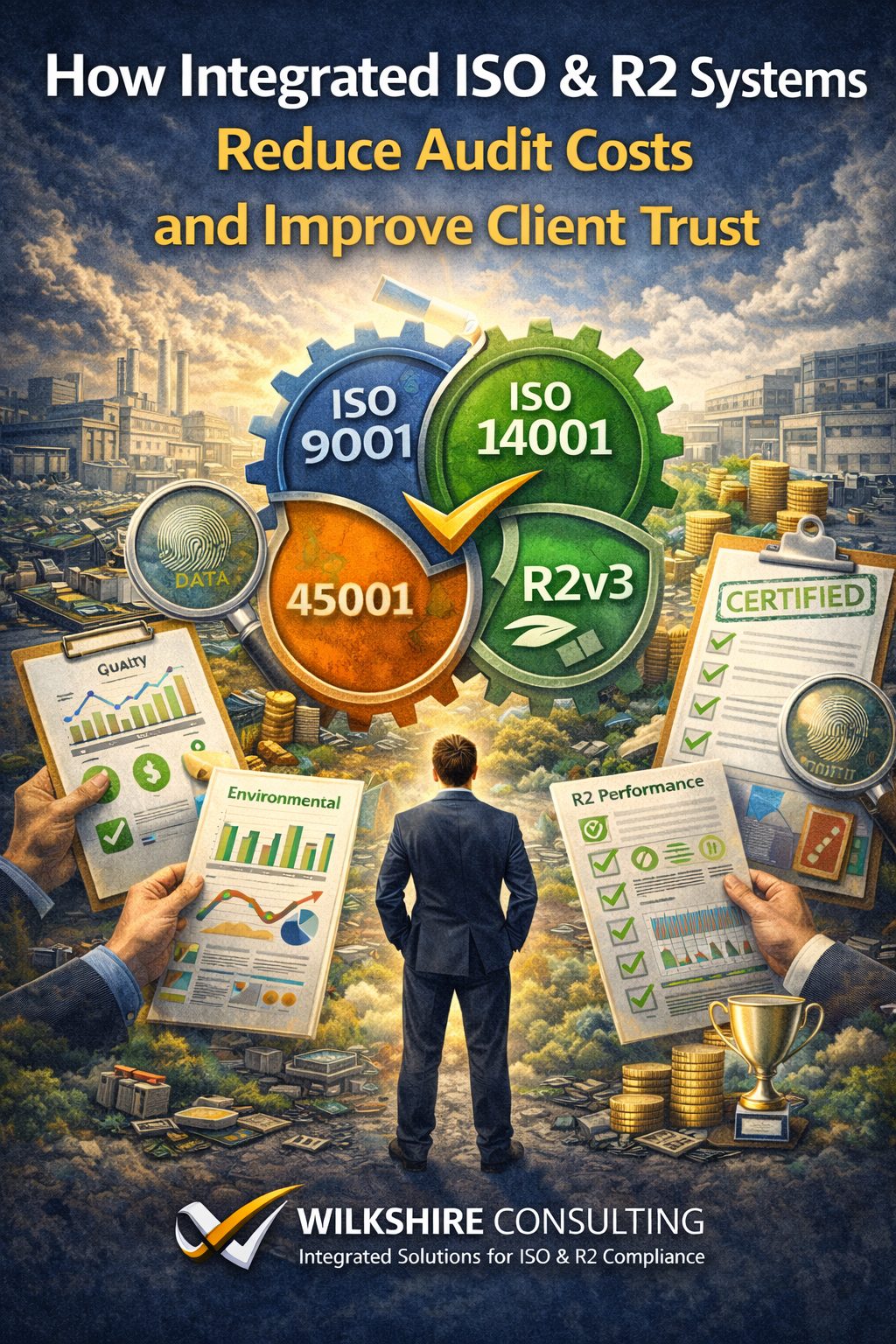
Interested in learning more about ISO & R2 integrated systems? Check out the blog below:
How Integrated ISO & R2 Systems Reduce Audit Costs and Improve Client Trust
What an Integrated Management Review Looks Like
An effective integrated management review consolidates all relevant inputs into a single, structured framework.
Instead of reviewing standards individually, leadership evaluates:
1. Overall System Performance
- Quality performance (ISO 9001)
- Environmental performance (ISO 14001)
- Safety performance (ISO 45001)
- R2v3 compliance metrics
This provides a unified view of operational effectiveness.
2. Risk Across the Organization
Rather than reviewing risks separately, leadership evaluates:
- Operational risks
- Environmental risks
- Safety risks
- Downstream/vendor risks
This allows for better prioritization and resource allocation.
3. Corrective Actions and Trends
Integrated systems track all nonconformities in one place.
Leadership can identify:
- Recurring issues
- Systemic weaknesses
- Areas requiring investment
This improves long-term performance.
4. Changes That Impact the Business
This includes:
- New equipment or processes
- Regulatory updates
- Customer requirements
- Expansion or restructuring
Evaluating these changes holistically ensures that all standards remain aligned.
5. Resource and Strategic Needs
An integrated review allows leadership to answer:
- Where should we invest?
- What risks require immediate attention?
- Are current systems scalable?
This turns management review into a forward-looking process.
Common Mistakes in Integrated Reviews
Even organizations attempting integration often fall into these traps:
Combining Meetings — But Not Content
Some organizations hold one meeting but still review standards separately within it.
This limits the benefit of integration.
True integration requires cross-functional discussion, not just shared scheduling.
Too Much Data, Not Enough Insight
Presenting excessive metrics without interpretation leads to disengagement.
Leadership needs:
- Trends
- Key risks
- Actionable insights
Not just reports.
Lack of Clear Outcomes
Management reviews should result in decisions, such as:
- Resource allocation
- Process improvements
- Risk mitigation actions
Without clear outcomes, the review adds little value.
Do you need to know what is coming on the new ISO 9001:2026 revision? Read below:
ISO 9001:2026 Is Coming – What Businesses Need to Know Now
The Benefits of Integration
Organizations that implement integrated management reviews consistently experience:
-
Reduced Administrative Burden
Fewer meetings, fewer reports, and less duplication.
-
Stronger Leadership Engagement
Executives are more likely to engage when discussions are strategic and relevant.
-
Better Risk Visibility
Leadership sees how issues interact across the organization.
-
Improved Audit Performance
Integrated systems demonstrate maturity and alignment — something auditors look for.
-
Greater Organizational Alignment
Departments operate under a shared understanding of priorities and risks.
Integration Supports Growth
As organizations expand — adding locations, certifications, or services — management complexity increases.
Integrated management reviews provide a scalable structure for maintaining oversight without increasing administrative burden.
This is particularly valuable for organizations managing ISO certifications alongside R2v3 requirements.
How Wilkshire Consulting Builds Effective Review Systems
At Wilkshire Consulting, we design management review processes that go beyond compliance.
Our approach focuses on:
- Structuring reviews around business performance
- Integrating ISO and R2v3 requirements
- Simplifying reporting while improving insight
- Supporting leadership decision-making
We help organizations transform management review from a requirement into a strategic advantage.
Because the goal of management review isn’t to look backward — it’s to guide what comes next.
Final Thought
If your management review feels repetitive, disconnected, or purely compliance-driven, it may be time to rethink the approach.
An integrated management review provides clarity, reduces duplication, and strengthens leadership oversight.
And in a world of increasing regulatory and customer expectations, that clarity is a competitive advantage.