Every four years, the FIFA World Cup captures the attention of billions of people around the globe.
Most fans see the matches, the players, and the excitement.
Businesses should be paying attention to something else entirely.
Behind every jersey, hat, banner, promotional item, and piece of official merchandise is one of the most controlled supply chains in the world.
Think about what’s at stake.
The FIFA World Cup is expected to generate billions of dollars in economic activity. Global brands invest enormous amounts of money to be associated with the event, and consumers expect official merchandise to be authentic, high quality, and delivered on time.
One supplier failure can create:
- Brand damage
- Revenue loss
- Product shortages
- Compliance issues
- Reputational risk
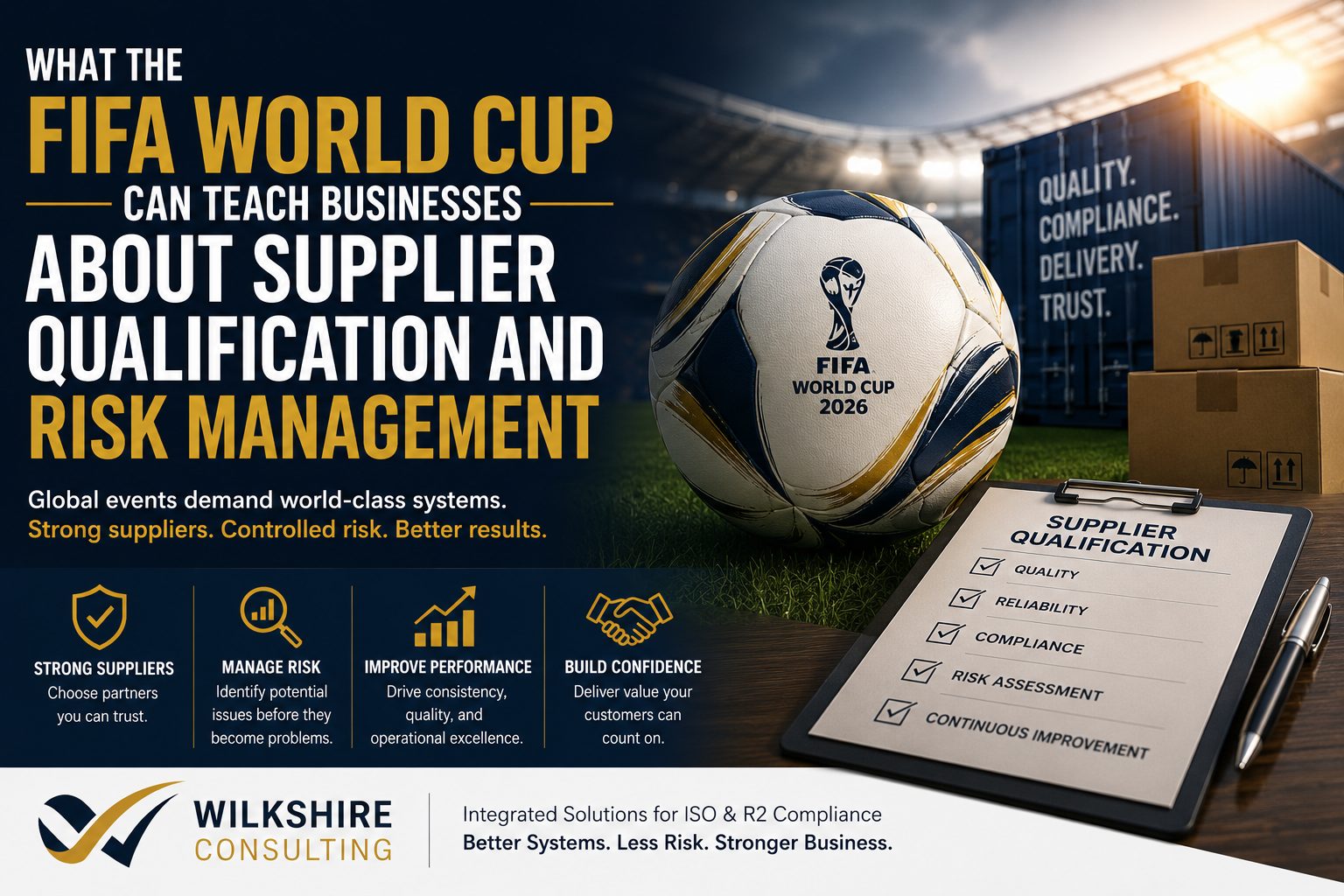
That’s why major global events like the World Cup depend on rigorous supplier qualification and risk management processes.
And while most businesses aren’t producing official FIFA merchandise, the lessons behind these systems apply to organizations of every size.
The Hidden Side of Major Global Events
When people think about the World Cup, they rarely think about supply chain management.
But behind every successful event is an enormous network of:
- Manufacturers
- Logistics providers
- Packaging suppliers
- Technology vendors
- Service providers
- Distribution partners
Every one of those suppliers represents risk.
And that’s exactly why organizations invest heavily in supplier qualification.
Because the question isn’t:
“Can this supplier provide the product?”
The real question is:
“Can this supplier consistently deliver what we need without creating problems?”
Those are two very different questions.
Why Supplier Qualification Matters More Than Ever
Many organizations still select suppliers primarily based on price.
That approach can work—until it doesn’t.
We’ve seen companies save a small amount on purchasing costs only to experience:
- Quality issues
- Delayed deliveries
- Customer complaints
- Compliance failures
- Increased internal workload
Suddenly the cheapest supplier becomes the most expensive decision.
The organizations behind major global events understand this.
That’s why supplier qualification isn’t simply a procurement activity.
It’s a risk management strategy.
The Best Suppliers Are Not Always the Cheapest
This is one of the biggest lessons businesses can learn from large-scale events.
The goal is not finding the lowest-cost supplier.
The goal is finding the supplier that creates the lowest overall risk.
Think about it this way.
If a supplier delivers:
- Consistent quality
- Reliable timelines
- Strong communication
- Effective corrective actions
They’re often worth significantly more than a cheaper alternative.
Because reliability has value.
And uncertainty has a cost.
Interested in learning more about ISO & R2 integrated systems? Check out the blog below:
How Integrated ISO & R2 Systems Reduce Audit Costs and Improve Client Trust
Supplier Risk Is Business Risk
Many companies treat supplier performance as someone else’s problem.
In reality, your suppliers become an extension of your business.
If they fail:
- Your customers feel it
- Your reputation suffers
- Your team spends time fixing issues
That’s why mature organizations evaluate supplier risk before problems occur.
Not after.
What ISO 9001 Teaches About Supplier Qualification
This is where ISO 9001 becomes incredibly relevant.
One of the core principles of ISO 9001 is controlling externally provided products and services.
In simple terms:
You must have confidence in the suppliers that support your operation.
Strong organizations don’t simply approve vendors and move on.
They continually evaluate:
- Performance
- Quality
- Delivery reliability
- Responsiveness
- Risk level
Because supplier management isn’t a one-time event.
It’s an ongoing process.
The World Cup Doesn’t Depend on Assumptions
Imagine organizing merchandise production for a global sporting event and simply assuming suppliers will perform.
No audits.
No evaluation.
No monitoring.
Nobody would accept that level of risk.
Yet many businesses operate this way every day.
They assume:
- Vendors will remain reliable
- Quality will stay consistent
- Risks won’t change
Until something goes wrong.
The strongest organizations remove assumptions from the equation.
They use data, monitoring, and performance reviews instead.
Risk Management Is About Prevention
One of the biggest misconceptions about risk management is that it’s reactive.
It’s not.
Effective risk management focuses on prevention.
Organizations behind major global events understand that fixing problems after they occur is expensive.
Preventing them is far cheaper.
That mindset applies to every business.
Instead of asking:
“How do we fix supplier issues?”
Ask:
“How do we identify supplier risks before they become supplier issues?”
That small shift changes everything.
Signs Your Supplier Qualification Process Needs Improvement
Many companies don’t realize weaknesses exist until problems appear.
Some common warning signs include:
- Frequent supplier-related corrective actions
- Quality inconsistencies
- Missed delivery deadlines
- Lack of supplier performance metrics
- Limited supplier oversight
- Decisions based primarily on price
If these issues sound familiar, it may be time to reevaluate your approach.
Strong Supplier Relationships Require Accountability
Supplier qualification isn’t about creating barriers.
It’s about creating confidence.
The best supplier relationships are built on:
- Clear expectations
- Performance measurement
- Communication
- Continuous improvement
When both parties understand what’s expected, performance improves.
That’s why world-class organizations don’t just manage suppliers.
They develop partnerships.
Interested in learning more about EHS under the R2v3 certification? Check out this blog:
Environmental, Health, and Safety (EHS) Management Under R2v3: Protecting Workers and the Planet
What Businesses Can Learn From the World’s Biggest Event
The FIFA World Cup may seem far removed from everyday business operations.
But the principles behind its success are remarkably relevant.
Major global events depend on:
- Qualified suppliers
- Risk-based decision making
- Performance monitoring
- Consistent processes
- Continuous improvement
Those same principles help businesses:
- Improve quality
- Reduce risk
- Strengthen customer confidence
- Support sustainable growth
The scale may be different.
The fundamentals are exactly the same.
How Wilkshire Consulting Helps Organizations Strengthen Supplier Qualification and Risk Management
At Wilkshire Consulting, we help organizations build management systems that reduce risk and improve operational performance.
We work with companies to:
- Strengthen supplier qualification programs
- Improve risk management processes
- Enhance ISO 9001 systems
- Develop meaningful performance metrics
- Create scalable operational controls
Because supplier issues rarely start with suppliers.
They start with systems that aren’t providing enough visibility, oversight, and control.
Ready to Reduce Supplier Risk and Improve Operational Performance?
If your organization is growing, managing multiple suppliers, or preparing for ISO certification, now is the time to evaluate how effectively supplier risks are being managed.
Strong supplier qualification processes don’t just reduce problems.
They create confidence, consistency, and long-term business success.