Many organizations pursue ISO certifications with good intentions: meet customer requirements, reduce risk, and demonstrate credibility. Yet year after year, companies struggle to maintain their certifications, fail surveillance audits, or discover that their ISO systems deliver little real value beyond a certificate on the wall.
The root cause is rarely a lack of effort. More often, it’s the absence of an integrated compliance strategy.
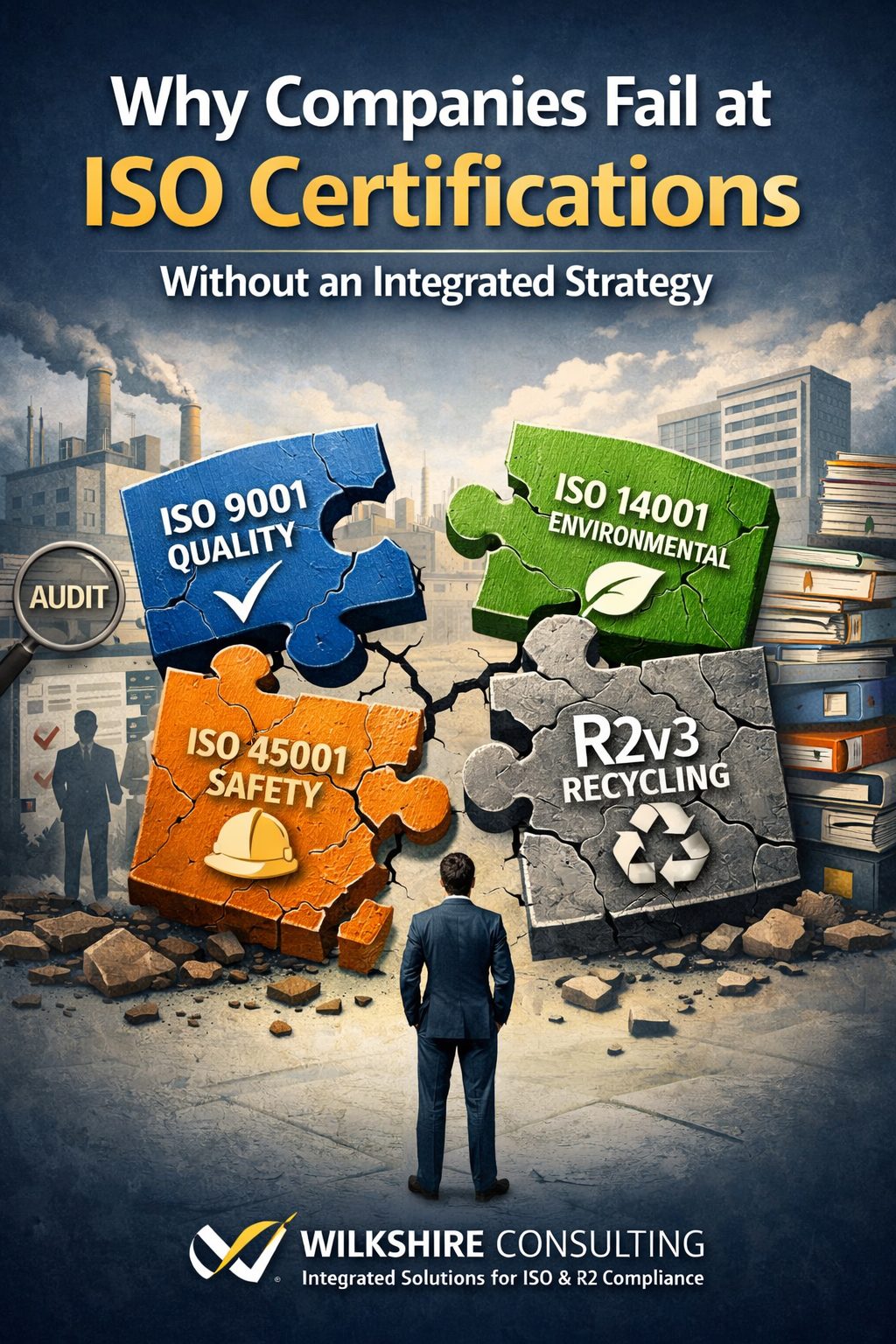
When ISO 9001, ISO 14001, ISO 45001, and R2v3 Responsible Recycling are treated as separate projects instead of components of a unified management system, inefficiencies multiply, risks increase, and long-term success becomes difficult to sustain.
The Problem with “One Standard at a Time”
Many organizations implement ISO standards reactively:
- A key customer requires ISO 9001
- A regulator raises environmental concerns, so ISO 14001 is added
- A safety incident prompts ISO 45001
- An enterprise client demands R2v3 certification
Each standard is implemented independently, often by different people, at different times, with different consultants or internal approaches. On paper, this may appear manageable. In practice, it leads to fragmented systems that compete for attention rather than reinforce one another.
Common symptoms of this approach include:
- Duplicate procedures addressing similar requirements
- Separate corrective action systems that don’t communicate
- Multiple management reviews covering overlapping topics
- Employees confused about which process applies to which standard
Over time, compliance becomes a maintenance burden rather than a business asset.
Certification Does Not Equal System Maturity
Achieving initial certification is not the same as building a sustainable management system. Certification bodies audit for conformity, not long-term effectiveness. Without a cohesive strategy, organizations often “pass the audit” but fail to embed the system into daily operations.
This is why many certifications struggle after the first year:
- Management attention shifts elsewhere
- Documentation becomes outdated
- Internal audits become checkbox exercises
- Corrective actions are reactive instead of preventive
An integrated strategy keeps standards aligned with how the business actually operates, even as priorities change.
Want to learn how auditors evaluate effectiveness under ISO 9001? Check out this post:
How Auditors Evaluate “Effectiveness” Under ISO 9001
The Hidden Costs of Siloed Compliance
Siloed compliance carries costs that rarely appear on a balance sheet but are felt across the organization.
**Audit Fatigue:**Multiple audits, each asking similar questions in slightly different ways, drain time and resources. Staff begin to see audits as disruptions instead of opportunities for improvement.
**Inconsistent Risk Management:**Quality, environmental, safety, and data security risks are interconnected. Treating them separately increases the chance that critical risks fall between systems.
**Leadership Disconnect:**When leadership receives fragmented reporting, it becomes difficult to understand overall organizational performance. Decisions are made in isolation rather than with a full risk and performance picture.
**Employee Resistance:**Frontline employees are far more likely to disengage when procedures feel redundant or disconnected from real work.
What an Integrated Strategy Actually Looks Like
An integrated management system does not mean “more documentation.” In fact, done correctly, it often results in less paperwork and more clarity.
Key characteristics include:
Shared Processes
Processes such as document control, corrective actions, internal audits, and management review should serve all applicable standards, not exist in parallel silos.
Unified Risk-Based Thinking
ISO 9001, 14001, 45001, and R2v3 all require risk assessment. An integrated approach evaluates operational, environmental, safety, and data risks together, providing leadership with a comprehensive risk profile.
Consistent Objectives and Metrics
Quality objectives, environmental goals, safety targets, and R2v3 performance indicators should align with business strategy, not operate independently.
Clear Accountability
Roles and responsibilities are defined across standards, preventing gaps or overlaps in ownership.
When systems are designed this way, compliance becomes part of how the organization runs — not something that happens before an audit.
Why Leadership Involvement Determines Success
No ISO standard can succeed without leadership engagement, but integrated systems make leadership involvement more effective and efficient.
Instead of reviewing four separate systems, leadership reviews one performance framework. Instead of reacting to audit findings, leadership evaluates trends, risks, and improvement opportunities across the organization.
This approach aligns directly with ISO’s intent: management systems that support business objectives, protect stakeholders, and drive continual improvement.
Find out What Auditors Actually Want to See in this blog:
ISO 9001 Management Review: What Auditors Actually Want to See
Integrated Systems Are More Resilient
Organizations with integrated strategies adapt more easily to:
- New customer requirements
- Regulatory changes
- Business growth or restructuring
- Multi-site operations
Rather than rebuilding systems for each new standard or requirement, the organization expands within a stable framework. This is particularly valuable for companies pursuing R2v3 alongside ISO certifications, where environmental, safety, and data security expectations overlap significantly.
Where Many Organizations Go Wrong
The most common mistake is assuming integration happens naturally after certification. In reality, integration must be designed intentionally.
Without guidance, organizations often:
- Integrate documentation but not processes
- Combine manuals but not accountability
- Share forms but not decision-making
True integration requires experience across multiple standards and industries — and a deep understanding of how auditors evaluate system effectiveness.
How Wilkshire Consulting Approaches Integration
At Wilkshire Consulting, we specialize in designing integrated management systems that support ISO 9001, ISO 14001, ISO 45001, and R2v3 under a single strategic framework.
Our approach focuses on:
- Reducing audit fatigue
- Eliminating redundant documentation
- Aligning compliance with operational realities
- Strengthening leadership oversight
- Building systems that scale as your business grows
Rather than treating standards as separate projects, we help organizations create systems that work together — improving compliance outcomes while delivering real business value.