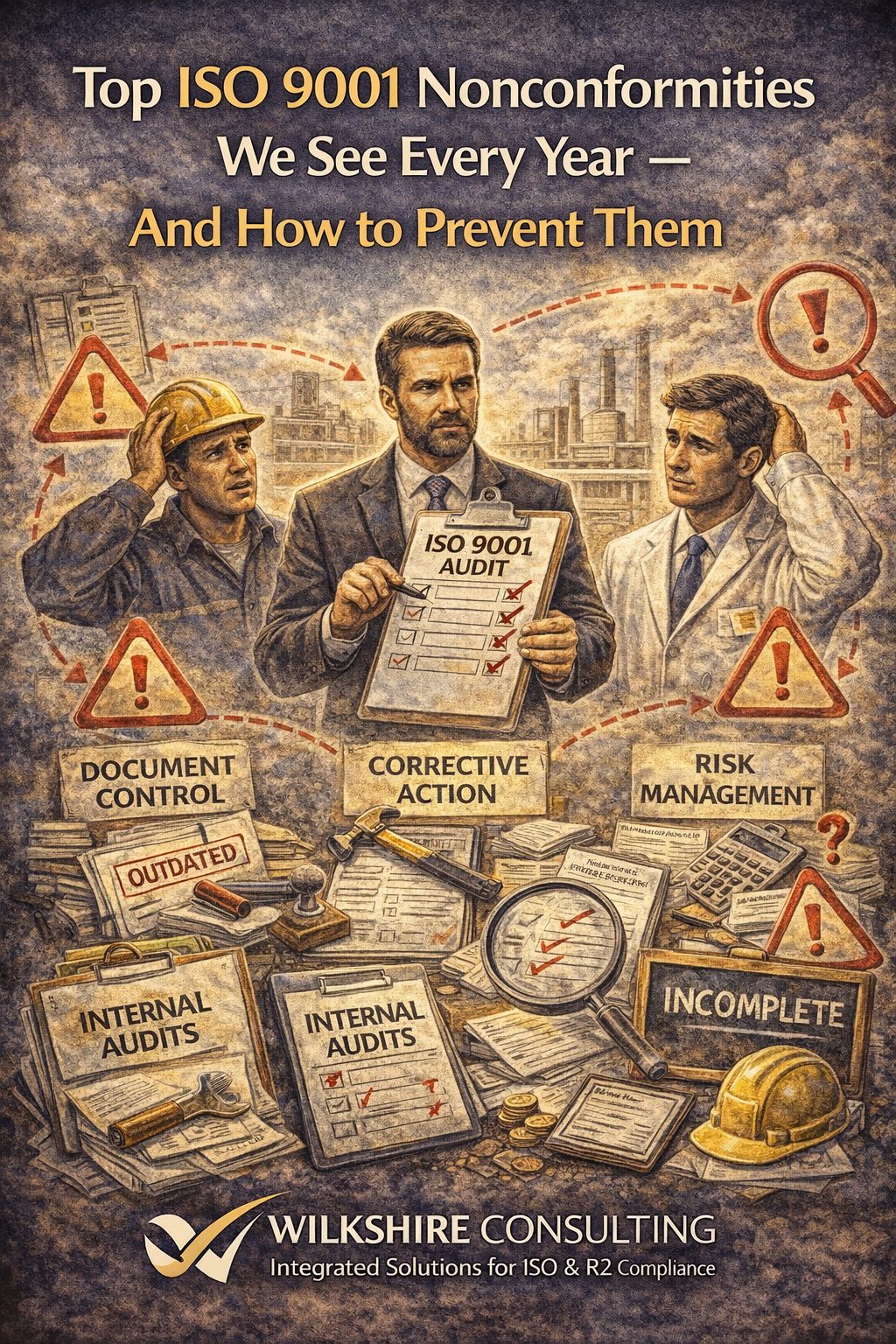
Every year, organizations across industries undergo ISO 9001 audits — and every year, the same nonconformities appear.
Despite differences in company size, industry, and complexity, the root causes of audit findings are often remarkably consistent.
This isn’t because organizations don’t care about quality. It’s because many systems are designed to pass audits initially, not to sustain performance over time.
Understanding the most common ISO 9001 nonconformities — and how to prevent them — can significantly reduce audit risk, improve operational control, and strengthen your quality management system.
1. Poor Control of Documented Information
One of the most frequent findings in ISO 9001 audits relates to document control.
Common issues include:
- Outdated procedures still in circulation
- Employees referencing incorrect versions
- Missing or incomplete records
- Lack of version control
While document control seems basic, it directly impacts system reliability. If employees are working from outdated information, process consistency breaks down.
How to Prevent It
- Implement clear version control processes
- Ensure only current documents are accessible at points of use
- Regularly review and update procedures
- Train employees on where to find controlled documents
Effective document control ensures that your system reflects current operations — not past assumptions.
2. Weak Corrective Action Processes
Corrective action is one of the most heavily scrutinized areas during audits — and one of the most common sources of findings.
Typical problems include:
- Addressing symptoms instead of root causes
- Repeating the same issues over time
- Lack of follow-up or effectiveness checks
When corrective actions are weak, problems persist — and auditors take notice.
How to Prevent It
- Use structured root cause analysis methods (not guesswork)
- Ensure corrective actions modify processes, not just fix issues
- Verify effectiveness after implementation
- Track recurring issues and trends
Strong corrective action systems demonstrate that your organization is actively improving.
3. Inconsistent Process Implementation
Many organizations have well-written procedures — but inconsistent execution.
Auditors often find:
- Employees performing tasks differently than documented
- Variations between shifts or departments
- Informal workarounds not reflected in procedures
This gap between documentation and reality is one of the fastest ways to generate nonconformities.
How to Prevent It
- Align procedures with actual workflow
- Involve employees in process development
- Conduct regular process reviews
- Reinforce expectations through training and supervision
Consistency is a key indicator of system control.
Interested in learning more about ISO & R2 integrated systems? Check out the blog below:
How Integrated ISO & R2 Systems Reduce Audit Costs and Improve Client Trust
4. Ineffective Internal Audits
Internal audits are intended to identify issues before certification bodies do. When they fail, audit findings increase significantly.
Common internal audit issues include:
- Superficial audits using generic checklists
- Avoiding high-risk areas
- Rushing audits before surveillance visits
- Lack of auditor independence
Weak internal audits signal to certification bodies that the system is not being effectively maintained.
How to Prevent It
- Train internal auditors to evaluate processes, not just check compliance
- Focus audits on risk areas and system effectiveness
- Schedule audits throughout the year — not just before external audits
- Ensure auditors are objective and independent
A strong internal audit program is one of the best predictors of audit success.
5. Lack of Risk-Based Thinking
ISO 9001 emphasizes risk-based thinking, yet many organizations struggle to demonstrate it.
Common gaps include:
- Risks identified but not linked to controls
- Risk assessments not updated when processes change
- No clear connection between risks and objectives
Auditors look for evidence that organizations are actively managing risk — not just documenting it.
How to Prevent It
- Integrate risk evaluation into daily operations
- Update risk assessments during process changes
- Link risks to controls and monitoring activities
- Include risk discussions in management review
Risk-based thinking should influence decision-making, not just documentation.
6. Poor Management Review Effectiveness
Management review is often treated as a formality — and auditors can tell.
Common issues include:
- Reviewing data without analysis
- Lack of leadership engagement
- No clear actions or decisions
- Missing required inputs
When management review is weak, it indicates a lack of system oversight.
How to Prevent It
- Focus on trends, risks, and opportunities
- Ensure leadership actively participates
- Document decisions and action items
- Use management review as a strategic tool
Effective management review demonstrates control at the highest level.
Do you need to know what is coming on the new ISO 9001:2026 revision? Read below:
ISO 9001:2026 Is Coming – What Businesses Need to Know Now
7. Inadequate Training and Competence
Organizations often assume employees are competent without verifying it.
Audit findings frequently include:
- Missing training records
- Employees unable to explain their roles
- Lack of defined competency requirements
Competence directly impacts process consistency and product quality.
How to Prevent It
- Define competency requirements for each role
- Maintain up-to-date training records
- Evaluate employee understanding — not just attendance
- Provide refresher training when processes change
Competence ensures that processes are executed correctly.
The Real Issue Behind Most Nonconformities
While these findings appear different on the surface, they often share a common root cause:
The management system is not fully integrated into daily operations.
When systems are:
- Maintained only for audits
- Owned by one department
- Disconnected from actual workflow
…nonconformities become inevitable.
How Wilkshire Consulting Helps Prevent Audit Findings
At Wilkshire Consulting, we focus on building ISO 9001 systems that function consistently — not just during audits.
Our approach includes:
- Identifying system gaps before certification bodies do
- Strengthening corrective action processes
- Improving internal audit effectiveness
- Aligning documentation with real operations
- Integrating ISO systems with R2, environmental, and safety frameworks
We help organizations reduce audit risk by improving how their systems actually perform.
Final Thought
ISO 9001 nonconformities are rarely caused by lack of effort. They are usually the result of systems that are not designed for long-term sustainability.
Organizations that focus on:
- Consistency
- Accountability
- Risk awareness
- Continuous improvement
…consistently achieve better audit outcomes.
Because in ISO 9001, success isn’t about avoiding findings — it’s about building a system that makes them unlikely.