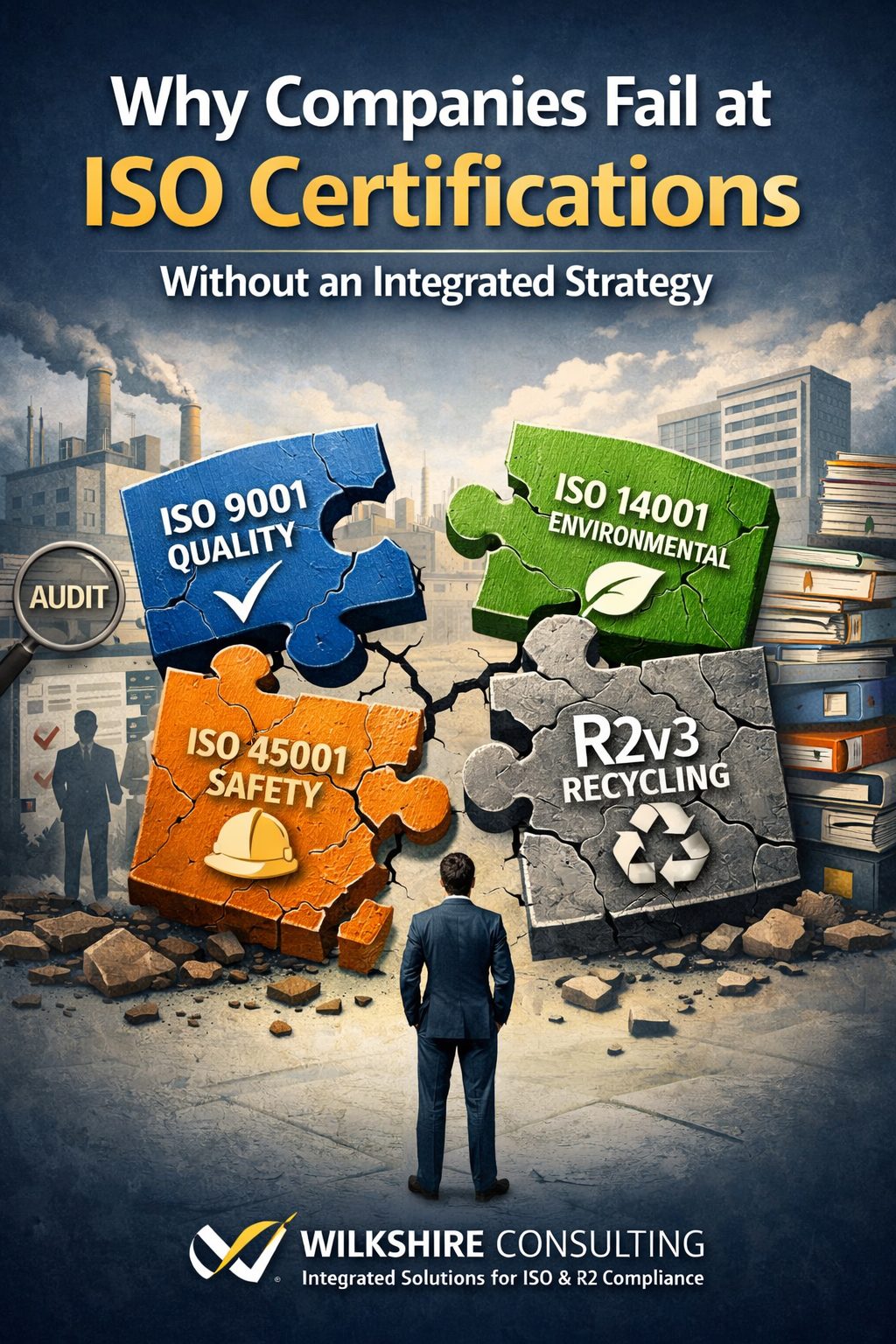

At Wilkshire Consulting, we often meet organizations that proudly earned ISO 9001 certification — only to struggle, stall, or fail during their first surveillance audit.
The pattern is surprisingly consistent.
The initial certification audit goes well. The certificate is issued. Celebration follows. Then, somewhere between Month 6 and Year 1, momentum fades. Processes drift. Leadership attention shifts. Documentation becomes outdated. By the time the surveillance audit arrives, the system feels fragile — and findings start to pile up.
The truth is this: ISO 9001 certifications rarely fail because companies don’t care. They fail because systems aren’t built for sustainability.
Let’s break down why ISO 9001 systems collapse after the first year — and how to build one that actually lasts.
1. ISO 9001 Was Treated as a Project Instead of a Management System
Why it fails
Many organizations approach ISO 9001 like a finite project:
- “Get the documentation done”
- “Pass the audit”
- “Move on”
Once certification is achieved, the QMS stops evolving. Procedures are no longer reviewed. Objectives aren’t updated. Internal audits are rushed or skipped. ISO becomes something you have, not something you use.
Auditors quickly detect this mindset shift.
How to avoid it
ISO 9001 must be embedded as a business operating system, not a one-time initiative.
To sustain success:
- Integrate ISO activities into normal business rhythms
- Treat the QMS as part of daily operations
- Assign ongoing ownership beyond the Quality Manager
- Schedule ISO activities across the year, not just before audits
A healthy QMS never “goes quiet” after certification.
2. Leadership Engagement Drops After Certification
Why it fails
During initial certification, leadership is often highly engaged. But once the certificate is issued:
- Management reviews become rushed or skipped
- Leadership stops attending ISO meetings
- Quality is no longer discussed at the executive level
- The QMS becomes “the quality department’s problem”
This directly violates ISO 9001 Clause 5 — and auditors notice quickly.
How to avoid it
Sustainable systems keep leadership involved by:
- Aligning quality objectives with business KPIs
- Using management review to drive real decisions
- Including ISO performance in leadership dashboards
- Tying QMS results to customer satisfaction and risk
When leadership sees ISO as a strategic tool, not a compliance obligation, engagement remains strong.
3. Internal Audits Become a Check-the-Box Exercise
Why it fails
Internal audits are often:
- Rushed right before surveillance audits
- Performed by untrained auditors
- Focused only on clause compliance
- Missing effectiveness evaluation
- Poorly documented
This results in missed issues that auditors uncover instead — which almost always leads to findings.
How to avoid it
An effective internal audit program:
- Covers all processes, not just clauses
- Uses trained, independent auditors
- Identifies real risks and inefficiencies
- Tracks findings to closure
- Verifies corrective action effectiveness
Strong internal audits prevent surprises and build audit confidence.
Find out What Auditors Actually Want to See in this blog:
ISO 9001 Management Review: What Auditors Actually Want to See
4. Corrective Actions Don’t Address Root Cause
Why it fails
Many organizations respond to issues quickly — but superficially.
Common failures include:
- Fixing symptoms instead of root causes
- Repeating the same nonconformities
- Poor documentation of root cause analysis
- No effectiveness verification
- No trend analysis
Auditors view repeated issues as evidence that the QMS is ineffective.
How to avoid it
Build a corrective action system that:
- Requires root cause analysis (5 Whys, Fishbone, etc.)
- Focuses on systemic causes
- Assigns ownership and deadlines
- Verifies effectiveness after implementation
- Trends issues to identify patterns
Corrective action should lead to learning, not just fixes.
5. Documentation Stops Reflecting Reality
Why it fails
After certification:
- Processes change but documents don’t
- Employees create workarounds
- Procedures become outdated
- Training no longer matches reality
Auditors frequently uncover this by interviewing employees and comparing answers to documented procedures.
How to avoid it
Maintain alignment by:
- Reviewing documents after process changes
- Involving process owners in updates
- Simplifying procedures to match real workflows
- Communicating changes effectively
- Removing unnecessary documentation
The golden rule still applies: Write what you do. Do what you write.
6. Quality Objectives Lose Meaning
Why it fails
Many organizations set quality objectives during certification — then forget them.
Common problems:
- Objectives are too vague
- Metrics aren’t tracked
- Progress isn’t reviewed
- Objectives don’t evolve
- Employees don’t know them
Auditors expect objectives to be living targets, not historical artifacts.
How to avoid it
Sustainable objectives are:
- Measurable and relevant
- Reviewed regularly
- Aligned with customer satisfaction
- Adjusted as the business changes
- Communicated across the organization
Objectives should drive improvement — not just satisfy a requirement.
Learn how to prevent common nonconformities before your audit with this blog:
Common ISO 9001 Nonconformities — And How to Prevent Them Before Your Audit
7. Risk-Based Thinking Isn’t Maintained
Why it fails
Risk-based thinking is often strong during implementation — then forgotten.
Failures include:
- Risk registers never updated
- New risks ignored
- No link between risks and controls
- Leadership unaware of key risks
Auditors increasingly expect risk thinking to be ongoing and integrated.
How to avoid it
Embed risk-based thinking into:
- Strategic planning
- Process changes
- Supplier evaluation
- Corrective actions
- Management reviews
Risk management should evolve as your business evolves.
8. The Organization Relies Too Heavily on One Person
Why it fails
Many ISO systems depend on:
- One Quality Manager
- One consultant
- One internal expert
When that person is overloaded, unavailable, or leaves, the system weakens rapidly.
How to avoid it
Build redundancy by:
- Training multiple internal auditors
- Cross-training QMS responsibilities
- Documenting processes clearly
- Ensuring leadership understanding
A resilient QMS survives personnel changes.
How Wilkshire Consulting Helps Clients Avoid Year-One Failure
At Wilkshire Consulting, we focus on long-term ISO sustainability, not just certification.
We help organizations:
- Build practical, scalable QMS structures
- Maintain leadership engagement
- Strengthen internal audit programs
- Improve management review effectiveness
- Simplify documentation
- Prepare confidently for surveillance audits
- Transition from “certified” to “high-performing”
Our goal is to make ISO 9001 work for your business — not against it.
Final Thoughts
ISO 9001 certifications don’t fail overnight. They fail slowly — through neglect, misalignment, and loss of momentum.
Organizations that succeed beyond year one:
- Treat ISO as a management system
- Keep leadership involved
- Audit themselves honestly
- Learn from issues
- Continuously improve
When ISO 9001 is sustained correctly, surveillance audits become routine — not stressful — and the QMS becomes a true driver of performance.
If your organization wants to move beyond “holding a certificate” and start using ISO 9001 as a competitive advantage, Wilkshire Consulting is here to help.