

How to Prepare for Your ISO 14001:2026 Transition Audit
- 11 minutes ago
- 5 min read
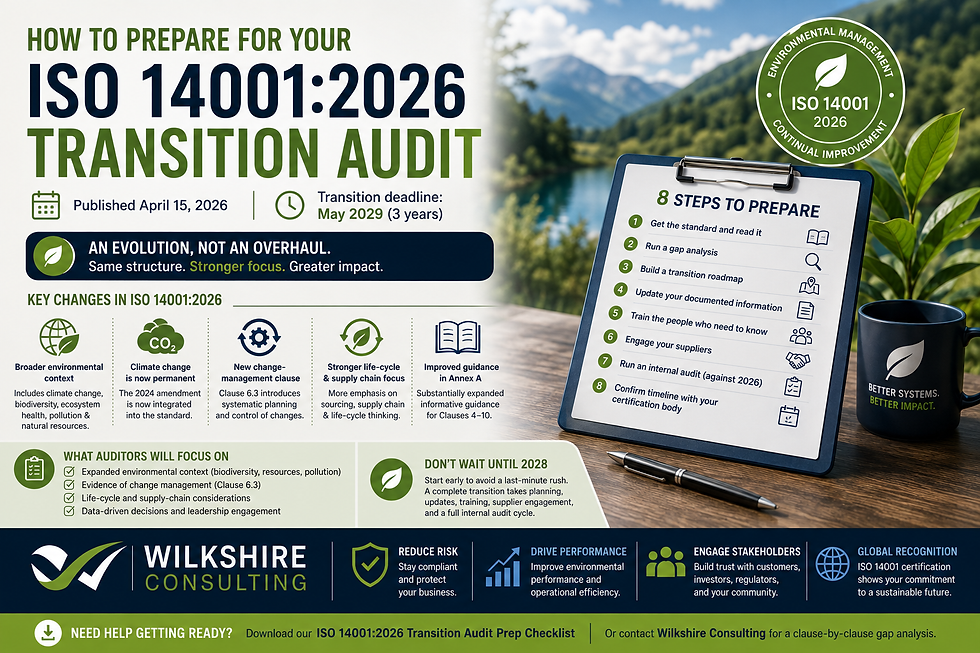
ISO 14001:2026 was published on April 15, 2026, which means the transition clock is officially running. If you're currently certified to ISO 14001:2015, you have until roughly May 2029 to move your certification to the new edition — a three-year window that sounds generous right up until you factor in gap analysis, system updates, training, supplier engagement, and at least one full internal audit cycle before your certification body ever shows up.
Here's the reassuring part: this is an evolution, not an overhaul. The core Annex SL structure and the Plan-Do-Check-Act model stay exactly where they are, and no existing 2015 requirements were removed. The changes are moderate — but "moderate" still means there's real work to do, and the organizations that start now will transition smoothly while the ones who wait will be scrambling in 2028. This walks through how to get ready.
First, Know What Actually Changed
You can't prepare for an audit against requirements you don't understand, so start here.
Environmental context got broader. Clauses 4.1 and 4.2 now more explicitly call out environmental conditions your context analysis needs to consider — not just climate change (which was folded in via the 2024 amendment), but biodiversity, ecosystem health, pollution levels, and the availability of natural resources. In practice this means your context review needs to be more detailed and better documented than it probably is today.
Climate change is now permanent, not an amendment. The 2024 climate change amendment is now baked directly into the standard. If you already addressed that amendment, you're ahead. If you treated it as a footnote, revisit it.
There's a new change-management clause. Clause 6.3, "Planning of changes," introduces systematic change management — the same concept already familiar from ISO 9001 and ISO 45001. When organizational changes affect your EMS, you now need to plan and control them deliberately rather than letting them happen ad hoc.
Life-cycle and supply-chain thinking is sharper. The revision puts more weight on life-cycle considerations, including sourcing and supply chain responsibility. These topics existed in the 2015 version but were often deprioritized or poorly implemented. Expect auditors to actually look for evidence this time.
Annex A guidance was substantially improved. The informative guidance that helps you interpret clauses 4 through 10 has been meaningfully expanded. This is genuinely helpful — use it while you prepare rather than treating it as filler.
Your Step-by-Step Transition Prep
1. Get the actual standard and read it
Not a summary blog (including this one). Buy the official ISO 14001:2026 text and read the real requirements. Everything downstream depends on your team understanding what's actually written, not what someone paraphrased.
2. Run a gap analysis
This is the single most important step. Compare your existing 2015-based EMS against the 2026 requirements, clause by clause, and document where you fall short. The gaps will cluster in predictable places: your context analysis (now needs biodiversity and resource considerations), your change management process (the new Clause 6.3), and your life-cycle/supply-chain documentation. A structured gap analysis turns a vague "we need to transition" into a concrete punch list.
3. Build a transition roadmap with real dates
Take the gaps and assign owners and deadlines. Work backward from your next recertification audit, not from the 2029 deadline — because your transition will most likely happen during a regular surveillance or recertification audit, not as a standalone event. If your recertification lands in 2028, your real deadline is 2028, not 2029.
4. Update your documented information
Revise the pieces the gap analysis flagged: your context analysis (Clauses 4.1/4.2), your risk and opportunity assessments, your new change-management procedure (6.3), and any life-cycle documentation. Don't rewrite your whole EMS — target the changes.
5. Train the people who need to know
Everyone who touches the EMS — not just your management rep — needs to understand what changed and why. Auditors in 2026 increasingly want to see that staff actually understand the system, not just that a training log exists. Make it real.
6. Engage your suppliers
The sharpened supply-chain and life-cycle expectations mean some of your transition work happens outside your own walls. Start those conversations early; supplier responsiveness is rarely fast.
7. Run an internal audit against the new requirements
Before your certification body audits you against 2026, audit yourself against 2026. This is where you catch the gaps your gap analysis missed and prove your updated system actually works in practice. Build in enough runway to fix what the internal audit finds.
8. Confirm the timeline with your certification body
Transition rules are set by the accreditation bodies, and some administrative details were still being finalized around publication. Ask your certification body directly: when will they audit you against 2026, and what do they need from you beforehand? Note that from October 1, 2027, recertification audits will incorporate transition requirements — so if your cycle crosses that date, plan accordingly.
What Auditors Will Actually Focus On
Expect transition-audit attention to concentrate on the things that changed: your expanded environmental context (can you show biodiversity, resources, and pollution were genuinely considered, not just listed?), evidence that the new change-management clause is being used, and documentation of life-cycle and supply-chain considerations. Modern EMS audits also lean harder on evidence than paperwork — auditors want to see decisions driven by environmental data and leadership actually engaged, not a tidy binder nobody references between audits.
Don't Wait for 2028 to Start
Three years feels like a long runway. It isn't, once you account for the full cycle: gap analysis, roadmap, documentation updates, training, supplier engagement, and an internal audit — ideally with time to fix findings before your certification audit. Organizations with well-established environmental management systems will already meet many of the clarified expectations, so for them this is mostly about documentation and evidence. Organizations that let their 2015 system drift will have more to do. Either way, the cheapest version of this transition is the one you start early.
Quick answers:
When was ISO 14001:2026 published?
April 15, 2026, replacing the 2015 edition.
What's the transition deadline?
Three years from publication — approximately May 2029. Certificates to the 2015 edition are no longer valid after that.
Is this a major rewrite?
No. The core structure and PDCA model are unchanged, and no 2015 requirements were removed. The changes clarify and modernize — mainly around environmental context, climate, biodiversity, change management, and supply chain.
When does my transition audit happen?
Usually during a regular surveillance or recertification audit within the transition window, not as a separate event. From October 1, 2027, recertification audits will fold in the transition requirements.
Do I need a gap analysis?
It's the most efficient way to transition — it converts the revision into a specific, ownable to-do list instead of a vague obligation.
Want help mapping your current EMS against ISO 14001:2026 so nothing slips through before your transition audit? Book a free call below!
Wilkshire Consulting Downloadable Documents:
ISO 9001:2015 Quality Management System Documentation Template Package
ISO 14001:2015 Environmental Management System Documentation Template Package
45001:2018 Occupational Health and Safety Documentation Template Package
ISO 9001 | ISO 14001 MS Integrated Documentation Template Package
(248) 890-9283


Comments