

R2v3 Certification Cost: What ITAD Companies Should Budget For in 2026
- Aug 6
- 4 min read
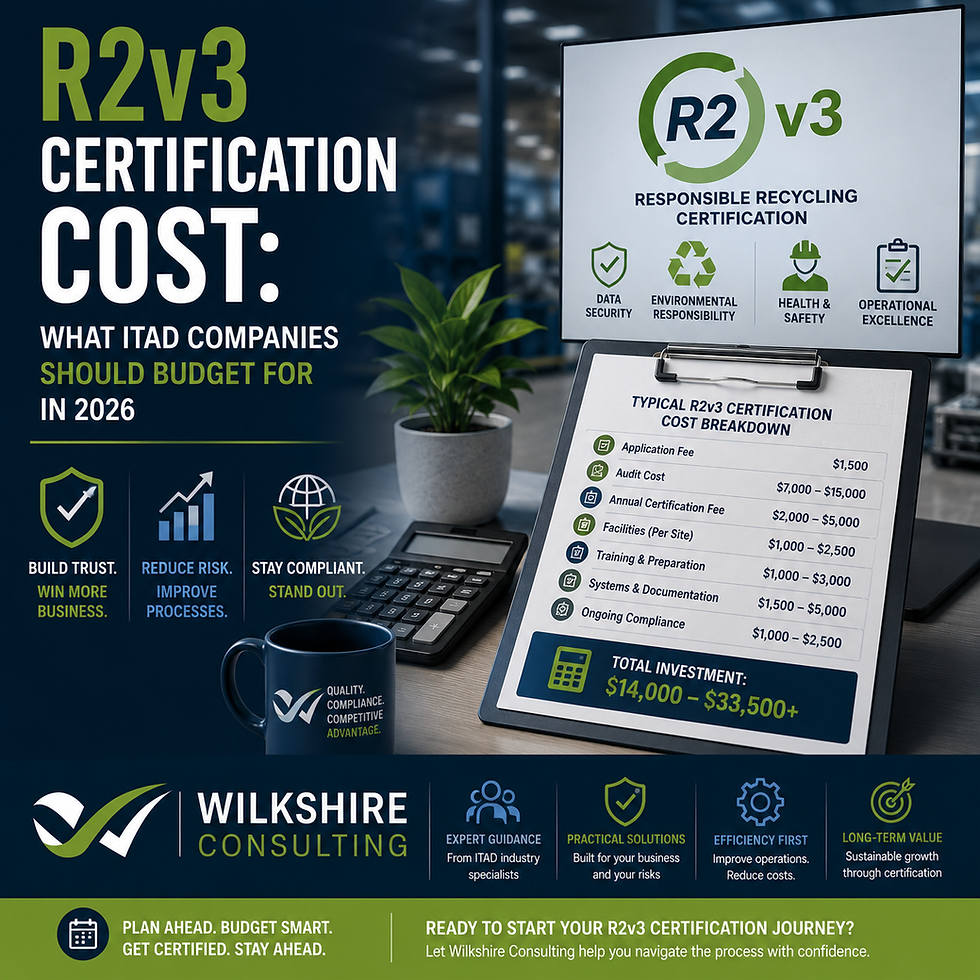
Most ITAD and electronics recycling facilities spend somewhere between $15,000 and $40,000 to get R2v3 certified for the first time. Larger or multi-site operations can push past $75,000. That's the honest range — anyone quoting you a flat number without asking about your facility first is guessing.
We get this question early in almost every consulting conversation, usually right after "how long will this take." Fair question. Certification isn't cheap, and it's not supposed to be — but knowing where the money actually goes makes it a lot easier to budget for, and a lot easier to spot if someone's overcharging you.
Where the Money Actually Goes
SERI licensing fees. This is the non-negotiable part. There's a one-time, non-refundable application fee of around $150, plus an annual SERI/R2 license fee of roughly $2,000 to stay in the program once you're certified. Small number in the grand scheme, but it's the floor everyone pays.
Required ISO standards. R2v3 doesn't stand alone — it requires implementing ISO 14001 (environmental management) and ISO 45001 (occupational health and safety) alongside it. Purchasing the standard documents themselves is cheap, around $150 each. Implementing them is where the real cost lives, especially if you're starting from zero.
Certification body audit fees. Expect somewhere in the $5,000 to $15,000 range for small to mid-sized facilities, covering your certification body's time to conduct the actual audit. Multi-site or higher-complexity operations run higher.
Consulting support (optional, but common). This is the variable everyone asks about. If you already have decent documentation and an existing quality culture, you might get through with minimal outside help. If you're building your management system from scratch, consulting can meaningfully shorten your timeline and reduce the number of nonconformities you rack up on your first audit. Costs here vary widely by scope and how much of the work you're outsourcing versus doing internally.
Training. Budget somewhere between $1,000 and $10,000 depending on staff size and how much your team already understands about R2v3 requirements. This tends to get underestimated — training isn't a one-time event, it's ongoing as your standard evolves and your staff turns over.
Internal time. Not a line item on an invoice, but real all the same. Someone on your team is going to spend hours pulling documentation, walking auditors through your facility, and fixing gaps. Don't ignore this cost just because it doesn't show up as a bill.
What Pushes You to the Low End vs. the High End
Facilities that already hold ISO 14001 or ISO 45001 certifications land toward the bottom of the range — you're not building those management systems from nothing, you're integrating R2v3's additional requirements into something that already exists. Facilities starting completely fresh or running multiple locations that all need to be brought into scope, land toward the top.
Timeline matters too. Certification typically takes 6 to 12 months start to finish. Facilities with strong existing processes have gotten there in 4 to 6 months. Rushing the process rarely saves money — it usually just means more findings on audit day, which means more corrective action work, which means more time and money spent fixing things you could have caught earlier.
Don't Forget the Ongoing Cost
Certification isn't a one-and-done expense. Plan on annual maintenance costs — surveillance audits and ongoing support — in the neighborhood of $3,000 to $8,000 a year. It's smaller than your initial investment, but it's a real, recurring line-item worth building into your annual budget from year one, not something you rediscover with surprise next year.
Is It Worth It?
For most ITAD companies chasing enterprise or federal contracts, yes. R2-certified facilities routinely command 20-40% higher prices on the assets they process, and a growing number of enterprise clients simply won't work with a vendor that isn't certified. The certification cost is real, but for most facilities in this market, it functions less like overhead and more like the price of admission to the contracts that actually move revenue.
A few quick answers:
Is R2v3 certification a one-time cost?
No — budget for annual license fees and surveillance audits on top of your initial certification investment.
Can I skip consulting help to save money?
You can, if your team already has strong documentation and QMS experience. Most facilities without that foundation find consulting pays for itself through fewer audit findings and a faster timeline.
Does certification cost scale with company size?
Yes, primarily through audit complexity and the number of locations in scope — a single-site operation with clean processes will always cost less than a multi-site facility building everything from the ground up.
Every facility's situation is different — the range above is real, but your actual number depends on where you're starting from. Get a custom R2v3 quote based on your facility's current setup.
Wilkshire Consulting Downloadable Documents:
R2v3 Responsible Recycling Documentation Template Package
Recycling Industry Operational Standard (RIOS) Documentation Template Package
(248) 890-9283


Comments